
How Arrest Warrants Work in Crane County
Texas Code of Criminal Procedure article 15.01 defines the arrest warrant simply. It is a magistrate's written order. The order directs a peace officer to arrest someone and bring that person before the magistrate. Article 15.02 lists what the paper must contain. That includes the accused's name or a reasonably certain description. It also states the offense and the magistrate's authority. Keep in mind that a warrant is only one process step, separate from the arrest itself, the bond decision, and the final case outcome. In Crane County, which court issues it turns on the charge and its stage, since the County Court, the 109th District Court, a JP, or the Municipal Court may each have a role. A district felony capias issued after indictment is different process. Confirm the exact term with the court.
Crane County Arrest Warrant Probable Cause
An arrest warrant in Crane County usually begins with a complaint or affidavit. It gives a magistrate facts for a probable-cause review. The county publishes no single intake route. No roster lists every magistrate either. Which clerk holds the record depends on the court and the case. A capias issued after indictment follows the Chapter 23 clerk process instead. That path differs from a pretrial arrest warrant. The Texas Code of Criminal Procedure, Chapter 15 sets the general arrest-warrant rules.
Arrest Warrants: What They Contain
Texas law names the core parts of arrest process. Crane County posts no sample person record and no local field format. Ask the court or clerk what information it can share. Also ask whether the record is public at all.
| Accused / subject | Name or reasonably definite description under the statutory warrant rules. |
|---|---|
| Offense | The accusation or offense connected with the process. |
| Issuing authority | Magistrate, judge, court, or clerk acting at a judge's direction. |
| Case number | Local warrant and cause-number format was not published. |
| Issue and return | Ask when it issued and whether execution or return is recorded. |
| Bond / status | Case-specific; no Crane public bond schedule or status-code list was found. |
In Crane County, do not confuse the date a warrant was served, a bond entry, and the final outcome of the case beneath it.
Crane County Executed Warrant Access
Article 15.26 makes an executed arrest warrant public. The same goes for its supporting affidavit. Crane County applies that rule only to executed process, though, and juvenile, sealed, or investigation-sensitive details can stay restricted or redacted.
Access question: Ask whether execution has been recorded and which clerk or agency holds the releasable copy. A no-result search is not a status certificate.
For a Sheriff's record, make a focused request. Name the agency, the date range, and the case identifier. For a court file, ask the issuing clerk how inspection and copies work. Texas Judicial Branch policy puts court case records outside the Public Information Act. The 109th District Court page adds Crane County contacts.

The 109th District Court page gives regional court context. It points users to Crane County contacts for local clerk help.
Crane County Warrant Service by Officers
A warrant commands a peace officer to act. Still, the issuing court and the serving agency have different jobs. Crane County's Sheriff, the Crane Police Department, and the Constable all post local law-enforcement contacts, but none of them posts a shared service schedule or a single list holding every court process. No public warrant unit appears either. The Constable page is one process-service contact. The Sheriff lists a general number, and city police handle city functions. Ask the issuing court whether the process went to an officer, and who can answer a custody or service question in Crane County.
Crane County Arrest Warrant Service Roles
The Sheriff may hold or serve county process. So may the Constable. Neither office takes the court's control over its case. The official Constable page lists a phone contact but no warrant counter or set service hours. The Sheriff page likewise posts no public warrant lookup for Crane County. Keep your inquiry narrow. Name the process, the issuing court, and the cause number. If service or custody is the question, ask the Sheriff which office holds it; ask the clerk about court status, bond terms, and the next setting. A general officer contact cannot promise how or when a warrant will be served, and the official Constable page gives the county's service contact.
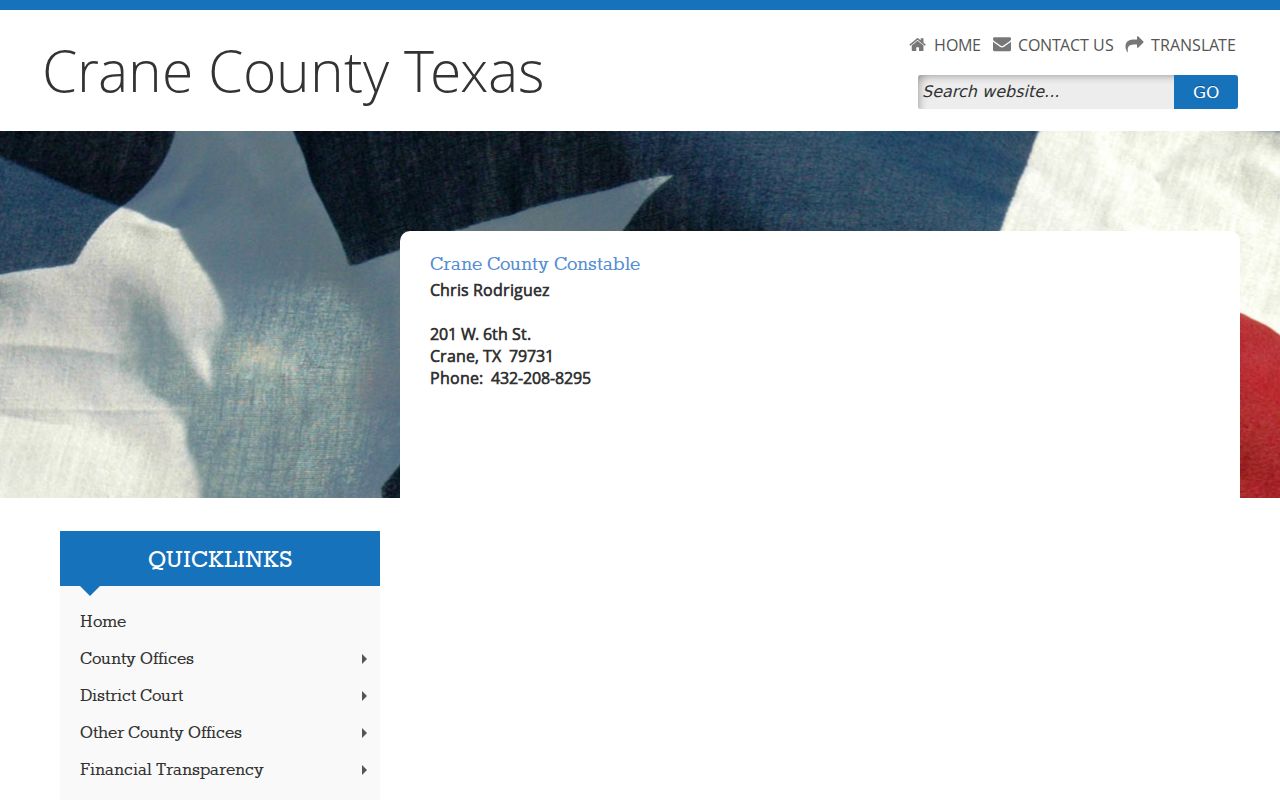
The Constable page is an official Crane County contact listing, not a public roster or warrant result.
Arrest Warrants, Summonses, and Bench Warrants
An arrest warrant lets a peace officer take a person into custody. A summons just tells the person to appear. A bench warrant can follow a missed date or noncompliance. In Crane County court files, a capias is a distinct criminal writ, and a capias pro fine enforces a judgment.
| Record type | Usual trigger | Crane contact |
|---|---|---|
| Arrest warrant | Magistrate finds probable cause on an offense. | Issuing court; Sheriff, Police, or Constable may serve. |
| Summons | Court directs a person to appear by notice. | Court named on the paper. |
| Bench process | Missed setting, contempt, or failure to follow an order. | Court that set the hearing. |
Use the exact wording in the court file. In Crane County, the type decides which clerk to call and which resolution step may be needed.
Federal Warrants Follow a Midland Route
Federal matters take a different route in Crane County. The county sits in the Western District of Texas, Midland/Odessa Division. A federal warrant or sealed federal case therefore never appears in a county JP or municipal warrant search. The federal clerk is the door for public docket access, and the U.S. Marshals Service is the contact for federal process. No county office can certify federal status. The official Western District page names the Midland courthouse and its division. PACER carries the public docket material, though an account is required and a sealed record may stay hidden. CourtListener/RECAP is only a partial, unofficial archive, not a warrant database. For service or a planned appearance, use official federal court contacts or counsel, since Crane County posts no federal warrant roster and no local surrender policy.
Handling an Arrest Warrant in Your Name
A notice in your mailbox deserves a real check. Verify any suspected arrest warrant through an official court or agency. Match the name and cause number against your own papers. Ask whether the process is active, executed, returned, or recalled, and whether a lawyer, bond, appearance, or motion is needed. Crane County publishes no guaranteed walk-in surrender instruction and runs no after-hours warrant desk.
Before appearing in person: Speak with an attorney if possible and call the issuing court or Sheriff to confirm where to report and what may happen on arrival.
A voluntary appearance, bond, or recall can end the warrant itself. The underlying case stays open. Ask the court for the next setting and written confirmation after any order. For the full contact sequence, see the Crane County warrant records overview.
After a Crane County Warrant Is Served
An arrest is only the first step. Magistration, bail, and the case's outcome are separate events. Texas law generally requires that a person go before a magistrate without unnecessary delay, and it sets a 48-hour framework for magistration and bail decisions, subject to statutory exceptions. That promises nothing about local release time or a bond amount. It says even less about how fast a court file updates. Once a Crane County warrant is served, ask which magistrate handled the matter. Ask what bond type and conditions apply, where the next hearing sits, and which office will update the warrant status. Want a copy of an executed warrant? Ask the proper clerk or agency whether it is public and what reproduction cost applies. Juvenile and sealed material is not a public sample.